
Habitat

Local Habitat Efforts
Inland Empire Chapter of Pheasants Forever's members are truly passionate about creating, preserving and restoring habitat that benefits pheasants, quail and other upland wildlife. This unique model empowers local chapters with the responsibility to determine how 100 percent of their locally-raised conservation funds will be spent.
Whether it's through improving habitat, informing the public about land management or educating future generations of hunting enthusiasts, conservation is the underlying principle in all we do at the grassroots level.

Revere
The Revere Wildlife Area is over 2,300 acres of Palouse grassland and shrub-steppe scabland terrain with seeps and springs in the Rock Creek drainage. The Inland Empire Chapter of Pheasants Forever has established 11 food plots and 31 fenced shrub plots. The food plots target pheasants but will aid all wildlife in this area to survive the winter and give them a jump start advantage in the spring. The shrub plots were planted in 2023 and 2025 to help restore habitat after the Wagner fire burnt most of the area.
April 2025 - Our biggest project to date!
On April 12, 2025, over 50 people from all over the state (and even Idaho) showed up to help with this project. Volunteers from Spokane Audubon Society, WDFW, Benton-Franklin chapter of PF, OnX, CarMax, WSU and our own chapter weathered the cold wind to plant 1575 shrubs in 3 separate plots and put up nearly 1/2 mile of fencing to protect them. Pollinator seeds and food plots were also prepared. 2025 Revere Photos
For our 2023 Habitat Project we planted 28 shrub plots at the Revere Wildlife Area in Whitman County following the Wagner Wildfire in August of 2022. Volunteers included folks from the Spokane and Puget Sound chapters of Pheasants Forever, Backcountry Hunters & Anglers, master hunters, a handful of Washington State University students, and WDFW staff from multiple programs. Together, we planted 700 native shrubs and trees to re-vegetate the area before invasive weeds can move in.
Please E-mail Mike Gruenke, our Habitat Chairman if you are interested in helping with future habitat work days.
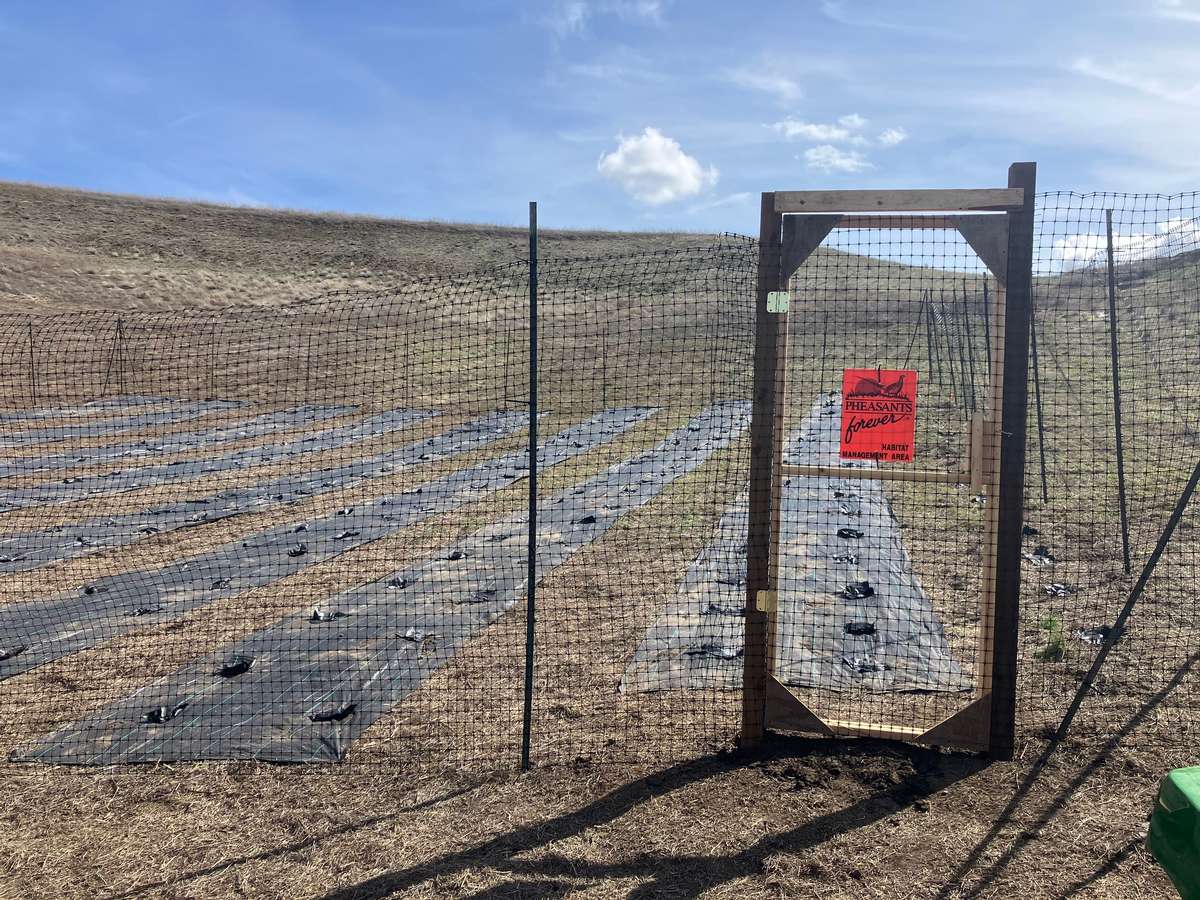
Pheasant Forever Shrub Plot
Lamont Habitat Project
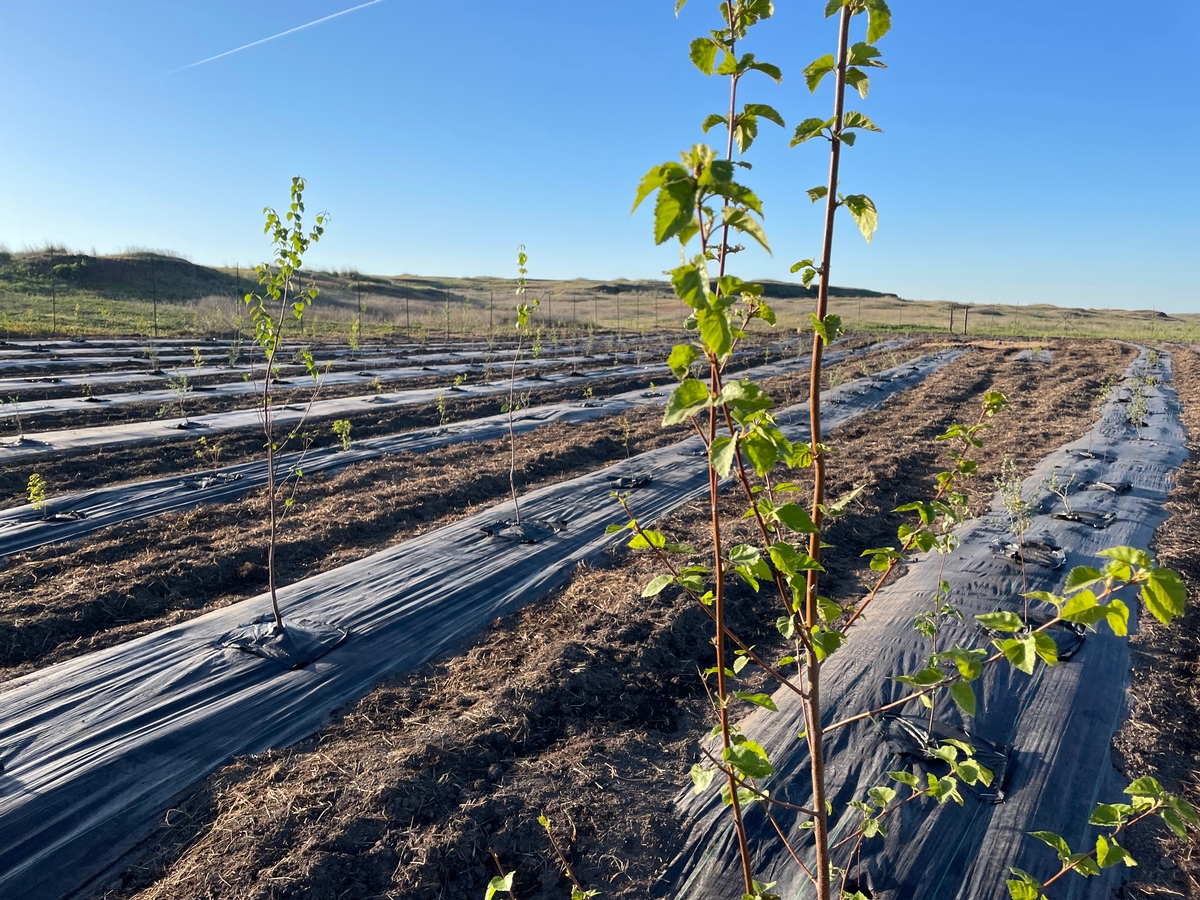
In April 2024 the chapter hosted a shrub planting on Feel Free to Hunt land near Lamont. The project involved planting 200-300 shrubs and trees. Size of the plants will 10” plugs. We also laid landscape fabric to help eliminate weed competition and to help retain moisture in the soil. We enclosed the planting area with a 320’ 7.5’ high deer fence using 10’ t posts to prevent deer and elk from browsing on the plants until they have a chance to mature.
Swanson Lakes
Read about it in the Spokesman Review or OnX Blog.
On May 11, 2024, chapter 800 built and planted a 225 foot by 100-foot (22,500 square foot) shrub plot with the goal of creating critically needed winter food source for sharp-tailed grouse, as well as thermal and escape cover for pheasants, valley quail, and other wildlife that reside at Swanson Lakes.
In total, 700 plants were put in the ground. Water Birch, Aspen, Chokecherry, Red Osier Dogwood, Buffaloberry, Serviceberry, Black Elderberry, and Douglas Hawthorn that ranged in size from 10- centimeter plugs to 2-gallon pots were planted. Weed barrier fabric was laid before the planting by Pheasant Forever volunteers and a deer fence enclosure was put up during the project to protect the plants.
This project was especially important to our chapter because Swanson Lakes is one of a few recovery areas for Columbian Sharp Tailed grouse as well as Sage Grouse in Washington. In 2020, a fire devastated this area and with it, much of the habitat wildlife depended on.

Packer Creek
The Packer Creek unit is a 1650 acre parcel of land, that is managed by the BLM, and is located approximately 16 miles south of Sprague Washington on Highway 23. For several years we have partnered with the BLM to plant hundreds of shrubs, trees, and native grasses.

Escures Ranch
In 2006 the Inland Empire Chapter 800 of Pheasants Forever in conjunction with the BLM coordinated a work project along Rock Creek to improve winter cover for upland birds. The project comprised of planting 350 shrubs and trees and installing a quarter mile of fence with two gates to protect newly panted shrubs and trees as well as established vegetation from cattle.
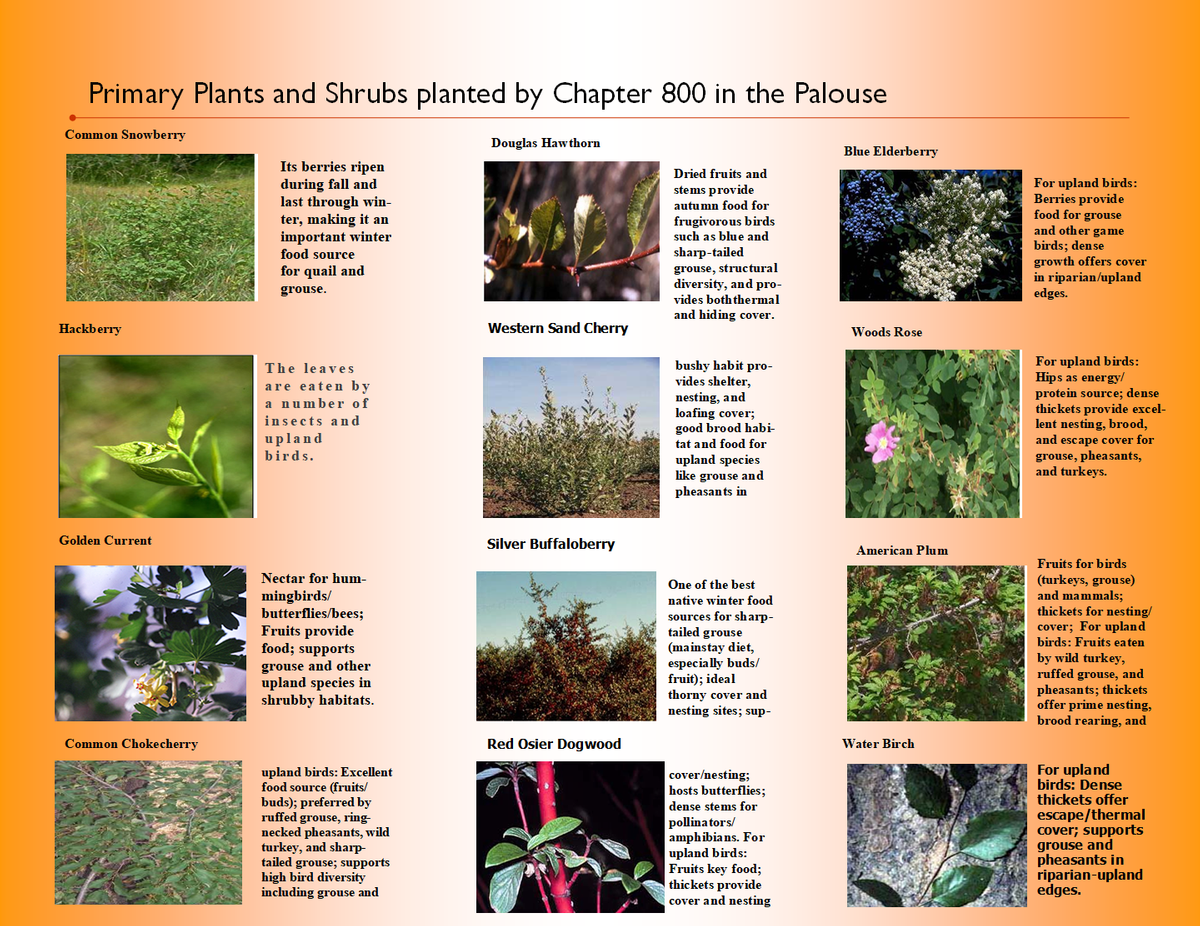
Primary Plants and Shrubs Planted by Chapter 800
Top Plants for Inland NW Upland Habitat
These are the plants that PF Chapter 800 has planted over the years and why we plant them:
Common Snowberry - Its berries ripen during fall and last through winter making it an important winter food source for quail and grouse.
Hackberry - The leaves are eaten by a number of insects and upland birds.
Golden Current - Nectar for hummingbirds, butterflies, and bees; Fruits provide food; supports grouse and other upland species in shrubby habitats.
Common Chokecherry - An excellent food source for upland birds preferred by grouse, pheasant, wild turkey. Supports high bird diversity.
Douglas Hawthorn - Dried fruits and stems provide autumn food for frugivorous birds such as blue and sharp-tailed grouse, structural diversity and provides thermal and hiding cover.
Western Sand Cherry - Bushy habitat provides shelter, nesting, and loafing cover; good habitat and food for upland species like grouse and pheasant.
Silver Buffaloberry - One of the best native winter food sources for sharptailed grouse (mainstay diet, especially buds/fruit). Ideal for thorny cover and nesting sites.
Red Osier Dogwood - Hosts pollinators and amphibians. Fruit provides a food source for upland birds with the thicket providing nesting cover.
Blue Elderberry - Berries provide food for grouse and other game birds; dense growth offers cover in riparian and upland areas.
Woods Rose - Hips are used as a food source and dense thickets provide excellent nesting, brood, and escape cover for grouse, pheasants, and turkeys.
American Plum - Food source for turkeys, grouse, pheasants, and mammals with nesting and brood cover.
Water Birch - Dense thickets offer escape and thermal cover supporting pheasant and grouse, best used along riparian-upland edges.
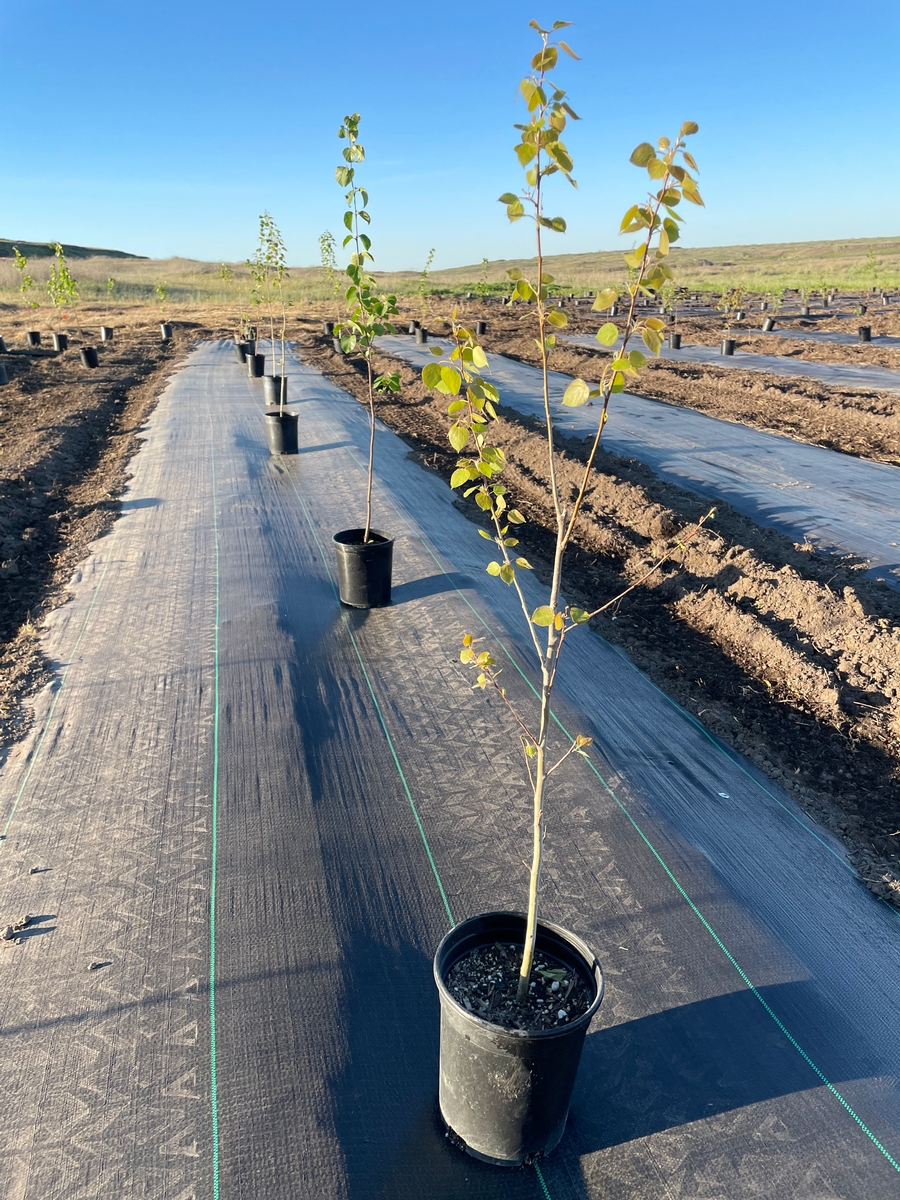
Top Fire Resistant Plants
Plants Beneficial for Pheasants and their Tolerance to Fire
These plants, are commonly recommended for pheasant habitat (providing cover, food like berries/hips, and thickets in the Palouse region. They vary with regards to fire tolerance. Fire tolerance refers to how well they survive or recover from wildfire or prescribed burns—often through sprouting from roots/rhizomes after top-kill, rather than being truly “fireproof.” No plant is completely fireproof, but many are fire-adapted or resistant due to high moisture content, resprouting ability, or low flammability.
Here’s a summary for each, based on reliable sources like USDA Forest Service Fire Effects Information System (FEIS), plant databases, and firewise guides:
American Plum (Prunus americana): Moderately fire tolerant. It is often top-killed by fire but resprouts vigorously from the root crown and roots. Mature plants with thicker bark may survive low-severity surface fires better. It can even benefit from fire in some habitats by promoting thicket formation and regeneration. Some firewise lists rate it moderately resistant (e.g., score 5 on certain scales).
Chokecherry (Prunus virginiana): High fire tolerance. It is well adapted to fire, resprouting rapidly and prolifically from root crowns and rhizomes after top-kill. It often increases in cover post-fire and appears in many fire-resistant plant lists for the Pacific Northwest and similar regions.
Common Snowberry (Symphoricarpos albus): High fire tolerance. Classified as a survivor with high resistance; top-killed but rhizomes (buried 2–5 inches deep) allow strong resprouting. It often recolonizes quickly after fire, even surviving moderate to severe burns in many cases. Frequently listed as fire-resistant in regional guides.
Woods’ Rose (Rosa woodsii): High fire tolerance. Strongly fire tolerant overall, with resprouting from rhizomes and root crowns after top-kill. It appears in firewise and native plant lists with moderate to good resistance ratings.
Golden Currant (Ribes aureum): Moderate fire tolerance. Top-killed by fire but recovers via resprouting or seeding; moderately tolerant in many sources. It shows up in some fire-resistant shrub lists (e.g., score 6 in certain databases), though recovery depends on fire severity.
Serviceberry (Amelanchier alnifolia): Moderate to high fire tolerance. Top-killed by moderate/severe fire but resprouts from the base; larger stems may survive light fires. It is fire-dependent in some habitats and often included in fire-resistant or post-fire recovery plantings.
Red-Osier Dogwood (Cornus sericea): Moderate fire tolerance. It appears in many Pacific Northwest fire-resistant shrub lists (often for moist/riparian sites), with good survival and resprouting potential. High moisture content in leaves/stems contributes to lower flammability.
Overall, most of these native shrubs are reasonably well-suited to fire-prone landscapes because they resprout after being top-killed, supporting habitat recovery post-fire. In wildlife habitat plantings (e.g., for pheasants), prescribed low-intensity burns can even benefit them by promoting denser growth and rejuvenation. options that also support birds and wildlife.
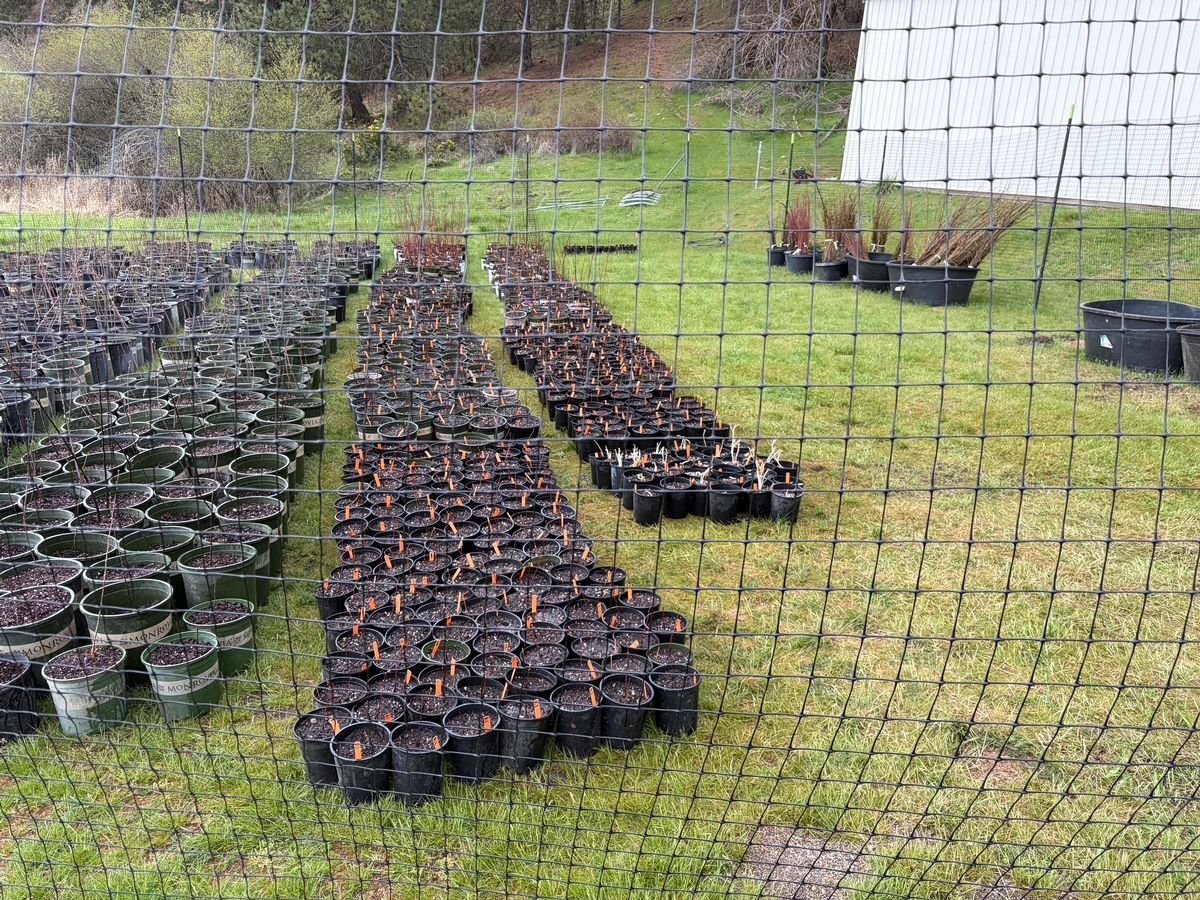
Plants at the nursery
Glen Tana Nursery
In partnership with the Inland Northwest Land Conservancy (INLC) we've contributed to the expansion at the beautiful Glen Tana property along the Little Spokane River. This collaboration lets our chapter buy small native seedlings, pot them up, and grow them out for a full season in the protected nursery space. That means way lower mortality when we plant them in the wild — and huge savings! We’ll have room for 3,500–4,000 one-gallon pots each season. By starting with smaller, cheaper plants and giving them that extra growing time, we’re slashing our plant costs by about two-thirds — that’s our biggest annual expense by far. The result? More funds to restore and enhance even more acres of prime habitat for pheasants, quail, upland birds, pollinators, and all the wildlife that calls our Inland Northwest home. This hands-on work builds on INLC’s awesome restoration efforts at Glen Tana — a key 1,000+ acre site connecting Waikiki Springs Preserve to Riverside State Park, supporting salmon recovery with the Spokane Tribe, and protecting vital river corridor habitat. Big thanks to INLC for this opportunity — together we’re making a real difference for conservation right here in Spokane’s backyard!